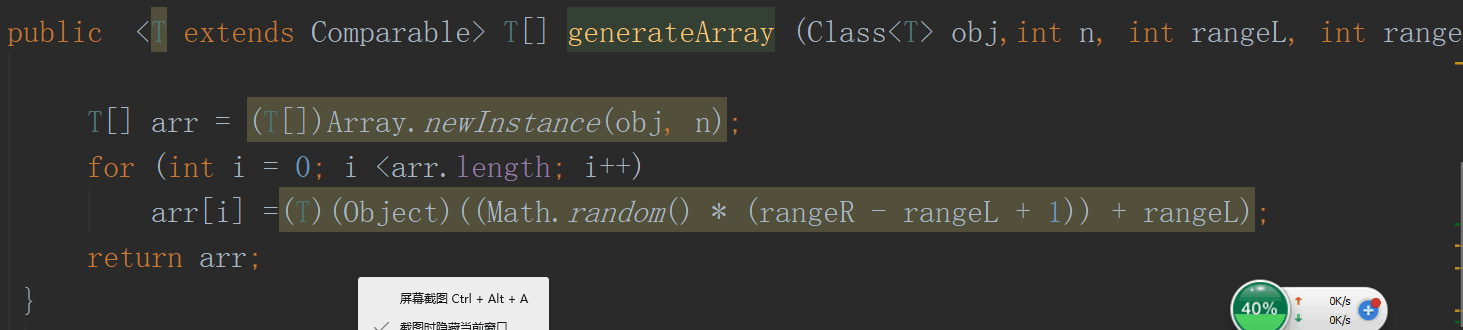
Math.random() * (rangeR - rangeL + 1) + rangeL 返回的是double,double可以强转成Object没问题,但是不能强转成Integer。你的obj传的肯定不是Double.class:)
实际上,对于这个函数,在Java中是不建议写成泛型函数的。Java的泛型本身就没有那么灵活。所以即使在标准库中很多地方也不使用泛型。尤其是只限定数字类型时。(对于你的这个例子,就是限定数字类型。因为根据你的函数语义,并不是生成随机的可比较元素的数组。比如字符串是可比较的,但字符串无法在int rangeL到int rangeR之间。)
比如Math.abs,取绝对值,Java标准库是怎么实现的呢?答案是这样的:根本不用泛型!:)
/**
 * Returns the absolute value of an {@code int} value.
 * If the argument is not negative, the argument is returned.
 * If the argument is negative, the negation of the argument is returned.
 *
 * <p>Note that if the argument is equal to the value of
 * {@link Integer#MIN_VALUE}, the most negative representable
 * {@code int} value, the result is that same value, which is
 * negative.
 *
 * @param   a   the argument whose absolute value is to be determined
 * @return  the absolute value of the argument.
 */
public static int abs(int a) {
    return (a < 0) ? -a : a;
}

/**
 * Returns the absolute value of a {@code long} value.
 * If the argument is not negative, the argument is returned.
 * If the argument is negative, the negation of the argument is returned.
 *
 * <p>Note that if the argument is equal to the value of
 * {@link Long#MIN_VALUE}, the most negative representable
 * {@code long} value, the result is that same value, which
 * is negative.
 *
 * @param   a   the argument whose absolute value is to be determined
 * @return  the absolute value of the argument.
 */
public static long abs(long a) {
    return (a < 0) ? -a : a;
}

/**
 * Returns the absolute value of a {@code float} value.
 * If the argument is not negative, the argument is returned.
 * If the argument is negative, the negation of the argument is returned.
 * Special cases:
 * <ul><li>If the argument is positive zero or negative zero, the
 * result is positive zero.
 * <li>If the argument is infinite, the result is positive infinity.
 * <li>If the argument is NaN, the result is NaN.</ul>
 * In other words, the result is the same as the value of the expression:
 * <p>{@code Float.intBitsToFloat(0x7fffffff & Float.floatToIntBits(a))}
 *
 * @param   a   the argument whose absolute value is to be determined
 * @return  the absolute value of the argument.
 */
public static float abs(float a) {
    return (a <= 0.0F) ? 0.0F - a : a;
}

/**
 * Returns the absolute value of a {@code double} value.
 * If the argument is not negative, the argument is returned.
 * If the argument is negative, the negation of the argument is returned.
 * Special cases:
 * <ul><li>If the argument is positive zero or negative zero, the result
 * is positive zero.
 * <li>If the argument is infinite, the result is positive infinity.
 * <li>If the argument is NaN, the result is NaN.</ul>
 * In other words, the result is the same as the value of the expression:
 * <p>{@code Double.longBitsToDouble((Double.doubleToLongBits(a)<<1)>>>1)}
 *
 * @param   a   the argument whose absolute value is to be determined
 * @return  the absolute value of the argument.
 */
public static double abs(double a) {
    return (a <= 0.0D) ? 0.0D - a : a;
}